
Using Data Without Overthinking
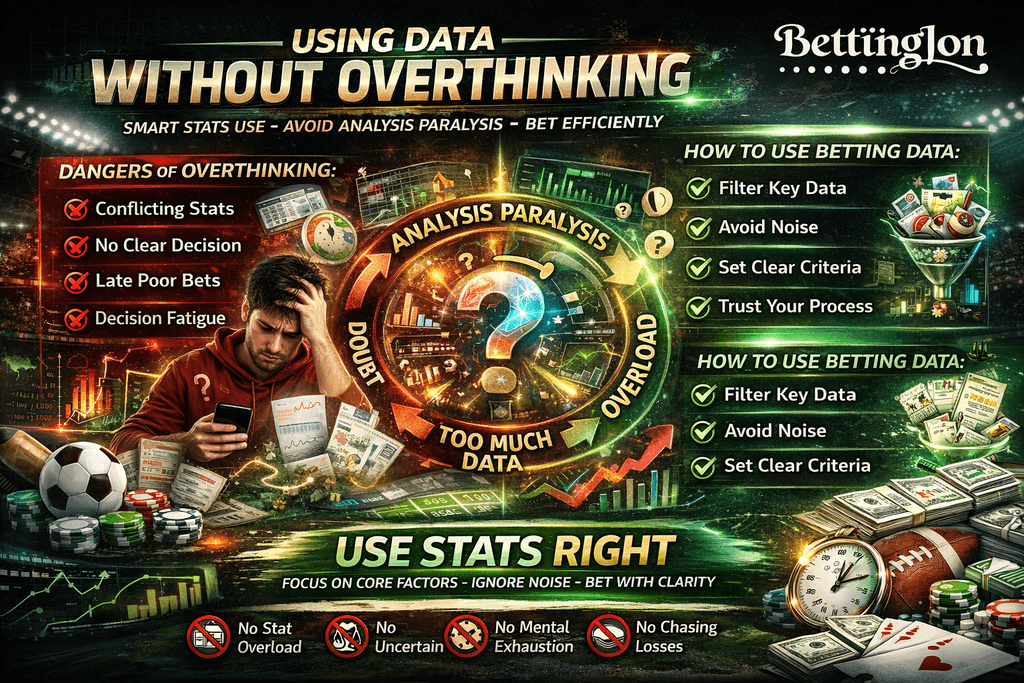
Data is everywhere in sports betting.
Team stats.
Player metrics.
Advanced analytics.
Historical trends.
At first, it feels like an advantage.
More data = better decisions.
Right?
Not always.
Because while data can improve your betting decisions, too much data — or using it incorrectly — can lead to something dangerous: analysis paralysis.
Understanding how to use betting data effectively without overthinking is one of the most valuable skills a bettor can develop.
What Is Analysis Paralysis?
Analysis paralysis happens when you have so much information that you struggle to make a decision.
Instead of clarity, you get:
- Confusion
- Doubt
- Delay
You start questioning everything:
- “What if I missed something?”
- “What if this stat matters more?”
- “What if the opposite is true?”
Eventually, decisions become slower — or worse, emotional.
Why More Data Isn’t Always Better
Data is only useful if it leads to better decisions.
But too much data creates noise.
Example:
You’re analyzing a football match and look at:
- Last 5 matches
- Last 10 matches
- Home vs away splits
- Head-to-head results
- Player injuries
- Possession stats
- Expected goals (xG)
- Weather conditions
At some point, the data stops helping.
And starts overwhelming.
More inputs don’t always mean better outputs.
The Illusion of Control
When using large amounts of data, players often feel:
“I understand this game completely.”
But that’s an illusion.
Sports outcomes are influenced by:
- Variance
- Random events
- Human error
- Unpredictable moments
No amount of data removes uncertainty.
Thinking it does leads to overconfidence.
The Goal of Data: Clarity, Not Complexity
Good use of data should simplify decisions.
Not complicate them.
Instead of asking:
“What else can I analyze?”
Ask:
“What actually matters here?”
Focus beats volume.
The Core Problem: Overfitting
Overthinking often leads to overfitting.
This means:
You create a narrative that perfectly explains past results — but doesn’t predict future outcomes.
Example:
“A team won 3 games after having less possession, so possession doesn’t matter.”
This might be true short-term.
But it may not hold long-term.
Overfitting creates false confidence.
The 80/20 Rule in Betting Data
Not all data is equally important.
Often:
- 20% of data provides 80% of insight
Focus on key variables:
- Team strength
- Match context
- Injuries
- Tactical setup
These matter more than minor details.
Building a Simple Data Framework
To avoid overthinking, use a structured approach.
Step 1: Identify Core Factors
Limit yourself to 3–5 key inputs.
Example:
- Team form
- Expected goals (xG)
- Squad availability
- Motivation/context
Step 2: Ignore Low-Impact Noise
Avoid overloading with:
- Irrelevant stats
- Small sample sizes
- Coincidental trends
Step 3: Set a Decision Threshold
Decide in advance:
“What level of confidence do I need to place a bet?”
If it’s not met — skip.
Step 4: Make the Decision
Avoid going back and adding more data after reaching a conclusion.
This is where overthinking begins.
The Trap of “One More Stat”
One of the biggest dangers:
“I’ll just check one more thing.”
This leads to:
- Contradicting data
- Increased doubt
- Decision fatigue
More data often weakens confidence — even if your initial read was correct.
Speed vs Accuracy
There’s a balance between:
- Thinking enough
- Thinking too much
Quick decisions without data are risky.
But endless analysis is equally harmful.
The goal is efficient decision-making.
Trusting Your Process
Confidence doesn’t come from knowing everything.
It comes from trusting your process.
If you:
- Use consistent criteria
- Apply it across bets
- Avoid emotional changes
…you reduce overthinking.
Consistency builds clarity.
When Data Conflicts
Sometimes data points in different directions.
Example:
- Team A has better form
- Team B has better underlying stats
In these situations:
- Don’t force a decision
- Accept uncertainty
- Skip if needed
Not betting is a valid outcome.
The Role of Experience
Experienced bettors use less data — not more.
Why?
Because they know what matters.
They’ve learned:
- Which stats are useful
- Which are misleading
- Which can be ignored
Experience filters noise.
The Emotional Side of Overthinking
Overthinking is often driven by fear:
- Fear of being wrong
- Fear of missing information
- Fear of losing
This leads to hesitation.
Or worse:
Late, rushed decisions.
Recognizing this helps you control it.
The Power of Simplicity
Simple decisions are often better decisions.
Not because they’re easier.
But because they focus on what matters.
Complexity can hide poor reasoning.
Simplicity exposes it.
A Practical Example
Instead of analyzing 20 variables, you might focus on:
- Team A: Strong home form + key players available
- Team B: Poor away record + missing defenders
If odds reflect a 50/50 game, but your analysis suggests Team A has an edge:
That’s enough.
You don’t need 10 more data points.
Common Mistakes to Avoid
1. Overloading With Stats
Too much information reduces clarity.
2. Changing Criteria Mid-Analysis
Stick to your framework.
3. Chasing Certainty
No bet is guaranteed.
4. Ignoring Context
Stats without context can mislead.
The Real Edge: Clarity
The goal of using betting data isn’t perfection.
It’s clarity.
Clear thinking leads to:
- Better decisions
- Faster execution
- Less emotional influence
Overthinking does the opposite.
Final Thoughts: Use Stats Right
Data is one of the most powerful tools in sports betting.
But only when used correctly.
Too little data leads to guessing.
Too much data leads to confusion.
The advantage lies in balance.
Focus on what matters.
Ignore the noise.
Trust your process.
Because the best bettors don’t know everything.
They just know what matters most.
Use stats right.